
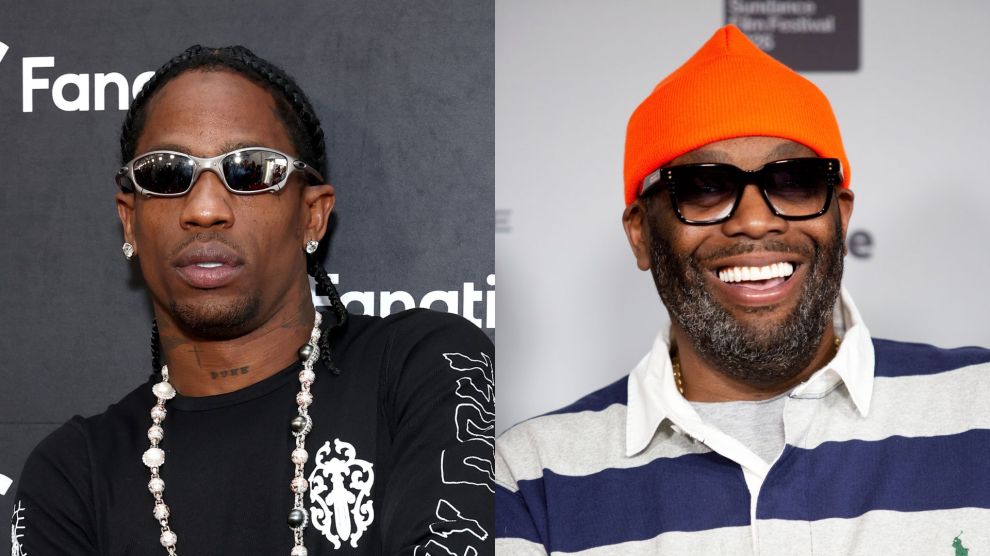
Travis Scott, Young Thug, and Killer Mike are among rap artists who are demanding the Supreme Court intervention in a death penalty case where a man’s own creative writing was used against him at sentencing.
James Garfield Broadnax, a 19-year-old Black man is currently scheduled to be executed on April 30 after his lyrics were used in his sentencing, per Pitchfork. Broadnax was found guilty by a predominantly white Texas jury in 2009 for two fatalities stemming from a robbery in the Garland area.
After his conviction, prosecutors introduced 40 pages of Broadnax’s handwritten lyrics into evidence. The material was examined on two separate occasions before ultimately recommending death instead of life without parole.
“The general theme of those lyrics,” as one prosecutor put it, was “robbing, killing and selling dope.” (Mr. Broadnax’s lawyers say prosecutors overlooked other themes, including regret and redemption. A lawyer for the state did not respond to a request for comment, per the New York Times.)
To secure the death penalty under Texas law, prosecutors must persuade the jury that the defendant is a continuing threat to society who will probably commit more violent acts.
Jury Selection
According to No Death Penalty, Black prospective jurors were removed in a disproportionate manner during jury selection: one Black juror compared to eleven white jurors ultimately served. Under U.S. law, prosecutors are not permitted to exclude jurors on the basis of race.
Rappers Intervene
The rappers argue that prosecutors mistook the Broadnax’s creative writing for a literal account amounting to a confession.
Scott, a multi-Grammy nominee, filed his supporting brief with SCOTUS on March 9. “The prosecutors argued Mr. Broadnax was likely to be dangerous in the future simply because he engaged in ‘gangster rap,’” Scott’s brief notes.
“Such an argument functionally operates as a categorical and straightforwardly unconstitutional content-based penalty on rap music as a form of expression.” The filing calls on the justices to draw a clear constitutional line around the use of artistic work as proof of criminal tendency.
Killer Mike and additional artists gave statements in a separate brief.
“Tales of violence, sex and criminal behavior sell to a broad swath of Americans — and any would-be gangsta rapper must learn and practice these conventions of the form,” said one of the briefs, filed on behalf of artists, industry professionals, scholars and arts organizations.
The creatives argue that Broadnax’s lyrics were irrelevant to his trial, as they were not cited during arguments over his guilt and were not introduced until the sentencing phase. “This case exemplifies the racial prejudice that infects a criminal proceeding when the State uses a defendant’s rap lyrics to capitalize on anti-rap bias, the misinterpretation of rap lyrics, and anti-Black bias triggered by rap music,” the filing reads.
Killer Mike, a rapper and political activist, raised a pointed objection to the lyrics being used in sentencing.
“This case exemplifies the racial prejudice that infects a criminal proceeding when the State uses a defendant’s rap lyrics to capitalize on anti-rap bias, the misinterpretation of rap lyrics, and anti-Black bias triggered by rap music,” the document states.