
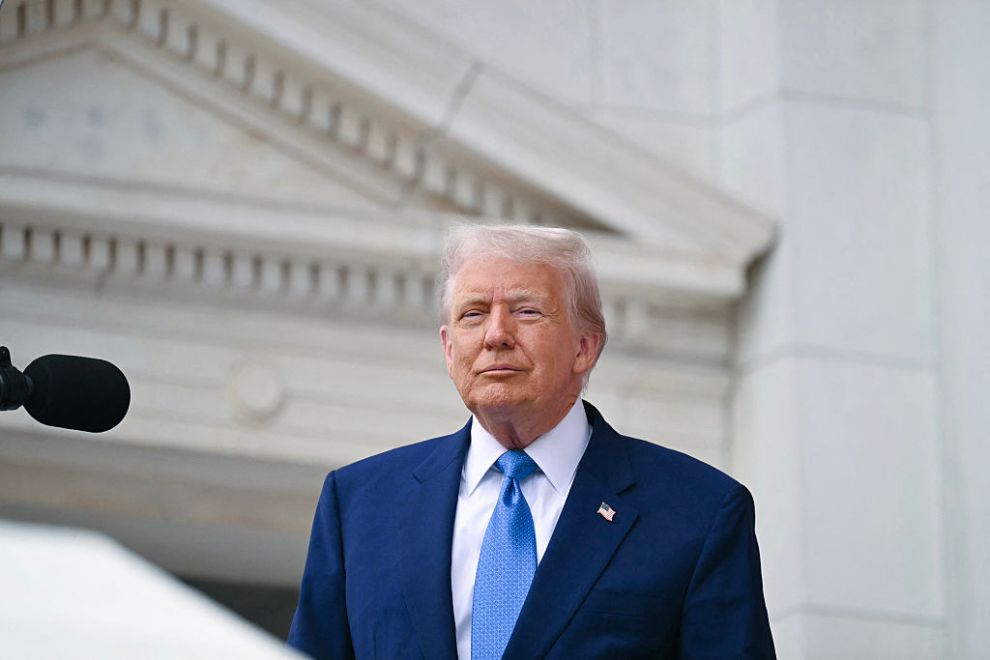
President Donald Trump celebrated a major Supreme Court victory Tuesday after the justices struck down longstanding federal limits on coordinated campaign spending between political parties and their candidates.
The 6-3 ruling removes caps that had restricted how much national and state political parties could spend in coordination with federal candidates. The decision marks another significant expansion of First Amendment protections in campaign finance law. It also comes months before the 2026 midterm elections.
Trump quickly praised the decision on Truth Social. He framed the ruling as a political victory for Republicans.
“A BIG WIN FOR REPUBLICANS,” Trump wrote in his post. “The Supreme Court has once again upheld the Constitution and our First Amendment Rights.”
The decision overturned a 2001 Supreme Court precedent that had upheld coordinated spending limits. Justice Brett Kavanaugh wrote the majority opinion. He concluded that the restrictions violated the First Amendment by limiting political parties’ ability to support their own candidates.
Court Expands Campaign Finance Protections
The legal challenge was brought by Republican organizations, including the National Republican Senatorial Committee, along with Republican officeholders. The plaintiffs argued that coordinated spending limits unfairly burdened political speech protected by the Constitution.
Federal law previously imposed spending caps based on the office sought and the state’s population. Those restrictions applied when political parties coordinated advertising and other campaign activities with candidates.
Independent political spending had already become largely unrestricted following the Supreme Court’s 2010 decision in Citizens United v. FEC. Tuesday’s ruling extends the court’s campaign finance jurisprudence by eliminating another major spending limitation.
Writing for the majority, Kavanaugh said the law violated constitutional free speech protections.
The ruling stated that restricting how parties support their own nominees could not survive constitutional scrutiny under the First Amendment.
The court’s conservative majority included three justices appointed by Trump during his first presidential term. Those appointments have continued shaping decisions involving elections, executive authority and social issues.
Republicans Cheer, Critics Warn of Donor Influence
Republican leaders applauded the decision almost immediately.
Sen. Tim Scott of South Carolina and Rep. Richard Hudson of North Carolina released a joint statement celebrating the outcome.
“This is a complete and total victory for the First Amendment and for every American who believes political speech should not be restricted by the federal government,” they said.
Democrats and campaign finance advocates criticized the ruling. They argued it weakens protections designed to prevent wealthy donors from gaining outsized political influence.
Justice Elena Kagan authored the principal dissent.
She argued that coordinated spending limits served an important anti-corruption purpose by preventing parties from functioning as extensions of individual campaigns.
The dissent warned that removing those limits “will invite donors to use parties as conduits for circumventing contribution limits,” according to the opinion.
Outside advocacy groups echoed those concerns.
The Brennan Center for Justice argued the ruling could make it easier for wealthy donors to exercise greater influence over federal elections by channeling larger sums through party committees.
The practical effects of the ruling could emerge quickly.
Republican committees currently hold a fundraising advantage entering the 2026 election cycle. Analysts say both major parties will likely adjust their fundraising and advertising strategies following the decision.
The ruling represents the latest chapter in the Supreme Court’s evolving interpretation of campaign finance law. It further narrows the government’s ability to regulate political spending while reinforcing the court’s view that many campaign expenditures qualify as protected political speech under the First Amendment.